
Lamya Essemlali Interview
Chilean Newspaper Crónica (Krill Wars)

Activist who confronted Norwegian fishing vessels in Antarctica: “The Chilean Navy is betraying its mission”
Interview with Lamya Essemlali, leader of the Krill Wars campaign.
“What the Chilean Navy is doing is betraying its main mission, which is to serve people and the ecosystem, not private companies.”
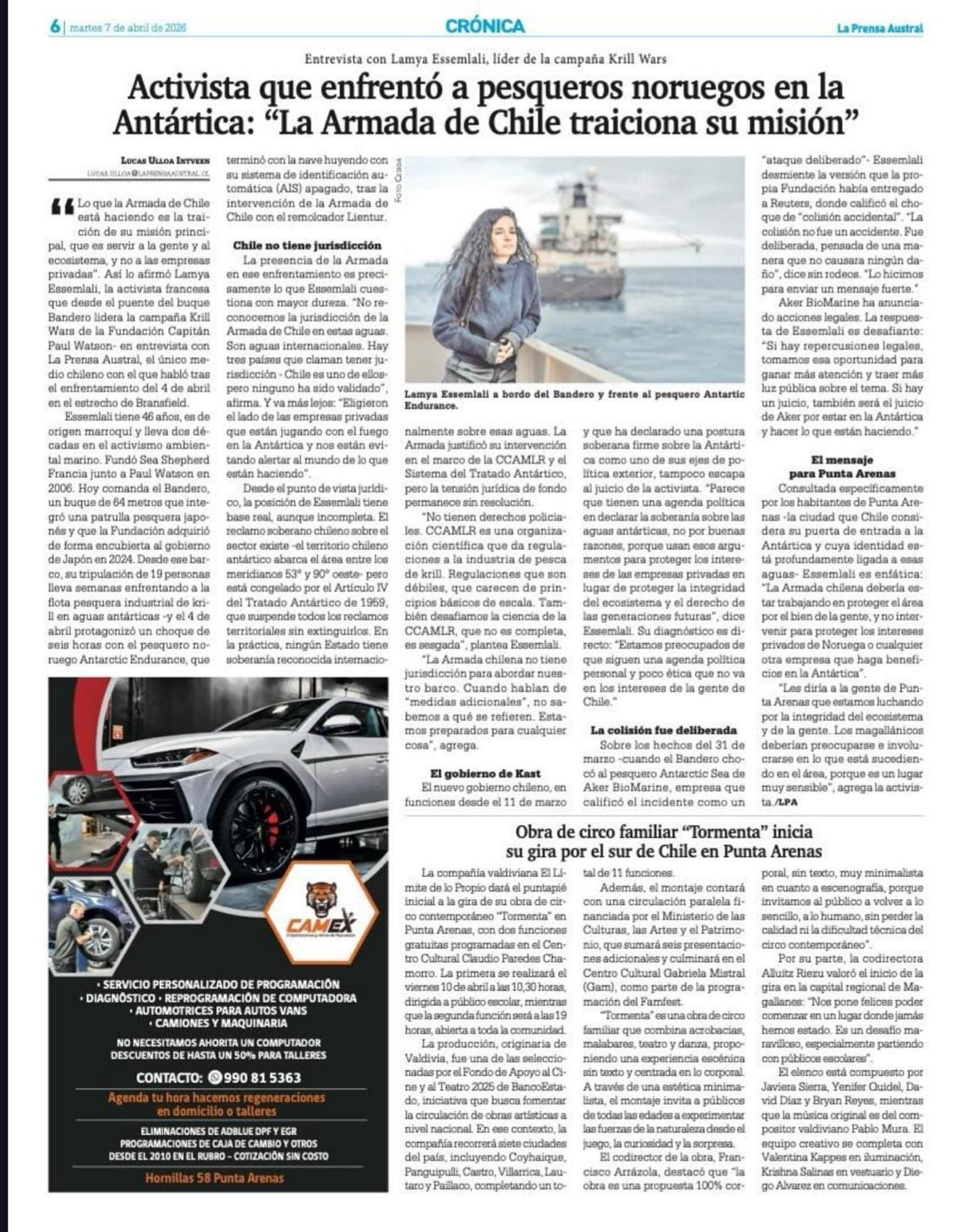
This is what Lamya Essemlali, the French activist who, from the deck of the ship Bandero, leads the Krill Wars campaign of the Captain Paul Watson Foundation, stated in an interview with La Prensa Austral, the only Chilean media outlet she spoke to about the confrontation on April 4 in the Bransfield Strait.
Essemlali, 46, of Moroccan origin and with two decades in marine environmental activism, co-founded Sea Shepherd France with Paul Watson in 2006. Today she commands the Bandero, a 64-meter vessel that carries out patrols against Japanese fishing fleets, and which the Foundation acquired in a covert manner from the Japanese government in 2024. With a crew of 19 people, she has spent weeks confronting the industrial krill fishing fleet in Antarctic waters, and on April 4 was involved in a six-hour confrontation with the Norwegian vessel Antarctic Endurance, which ended with the ship fleeing with its automatic identification system (AIS) turned off, after the intervention of the Chilean Navy with the tugboat Lientur.
Chile has no jurisdiction
The presence of the Chilean Navy in that confrontation is precisely what Essemlali questions most strongly:
“We do not recognize the jurisdiction of the Chilean Navy in these waters. These are international waters. There are three countries that claim jurisdiction — Chile is one of them — but none has been validated,” she states.
And she goes further:
“They have chosen to side with private companies that are playing with fire in Antarctica and are devastating the ecosystem without alerting the world to what they are doing.”
From a legal point of view, Essemlali’s position has a real basis, although incomplete. The Chilean claim over the Antarctic territory covers the area between the meridians 53° and 90° west, but it is frozen by Article IV of the Antarctic Treaty of 1959, which suspends territorial claims without extinguishing them. In practice, no State has internationally recognized sovereignty over those waters.
The Navy justified its intervention within the framework of CCAMLR and the Antarctic Treaty System, but the underlying legal tension remains unresolved.
“They do not have police powers. CCAMLR is an organization that regulates scientific research and the krill fishing industry. Regulations that are weak, lacking basic scientific criteria at scale. We also question the science of krill. In CCAMLR, which is not complete, it is biased,” Essemlali states.
“The Chilean Navy does not have jurisdiction to board our vessel. When they speak of ‘additional measures’, we don’t know what they mean. We are prepared for anything,” she adds.
The Kast government
The new Chilean government, in office since March 11, has declared a sovereign stance on Antarctica as one of the axes of its foreign policy, something that does not escape the activist’s criticism:
“It seems they have a political agenda in declaring sovereignty over Antarctic waters, not for good reasons, but to use those arguments to protect private companies instead of protecting the integrity of the ecosystem and the rights of future generations,” says Essemlali.
Her diagnosis is direct:
“We are worried that they are following a personal and political agenda that no longer aligns with the interests of the people of Chile.”
“The collision was deliberate”
Regarding the events of March 31 — when the ship Bandero collided with the fishing vessel Antarctic Sea of Aker BioMarine, a company that described the incident as an “accidental collision” — Essemlali rejects that version:
“It was not an accident. It was deliberate, even though it caused no damage,” she says without hesitation. “We did it to send a strong message.”
Aker BioMarine has announced legal actions. Essemlali’s response is defiant:
“If there are legal repercussions, we will take that opportunity to gain more attention and bring more public awareness to the issue. If there is a trial, it will also be a trial of Aker for being in Antarctica and doing what they are doing.”
Message for Punta Arenas
Asked specifically about the inhabitants of Punta Arenas — the city that Chile considers its gateway to Antarctica and whose identity is deeply linked to those waters — Essemlali is emphatic:
“The Chilean Navy should be working to protect the common good, not intervening to defend the private interests of Norway or any other company that profits from Antarctica.”
“The people of Punta Arenas should understand that we are fighting for the integrity of the ecosystem and for people. The people of Magallanes should be concerned and get involved in what is happening in the area, because it is a very sensitive place,” the activist adds
.